Gorilla trekking with health conditions is usually possible. Many older guests trek with something, from knee replacements to controlled blood pressure, and the right support makes the difference. The conditions that rule it out are uncontrolled ones, very recent surgery, and any infectious illness on trek day.
This page is a planning guide from an operator, not medical advice. It explains which conditions usually work, what helps, what to ask your doctor, and what medical help exists near Bwindi. It is part of our guide to gorilla trekking for seniors and disabled travelers.
Can You Go Gorilla Trekking With Health Conditions?
Yes, you can usually go gorilla trekking with health conditions that are stable and that your doctor is happy with. The trek is hard on joints, heart and lungs, so the question is which support you need, not whether you can go.
Three things decide it: how stable your condition is, how well you walk on uneven ground, and whether your doctor clears you for several hours of hill walking at altitude.
Which Health Conditions Work for Gorilla Trekking?
Joint replacements, arthritis, controlled blood pressure, controlled diabetes and mild asthma usually work, with porters, the right sector, and a doctor’s approval.
| Condition | Usually possible? | What helps most |
|---|---|---|
| Knee or hip replacement | Yes, once your surgeon is happy | Two porters, Buhoma sector, walking stick |
| Arthritis | Yes | Two porters, or a sedan chair if walking is painful |
| Controlled high blood pressure | Yes, with your doctor’s approval | A slow pace, rests, the lowest sector |
| Stable heart disease | Ask your cardiologist first | A sedan chair, the lowest sector |
| Controlled diabetes | Yes | Snacks and medication carried by your porter |
| Mild asthma | Usually | Inhaler in your pocket, a slow pace |
| Back problems | Depends on severity | Two porters. Chairs jolt, so ask your doctor. |
| Parkinson’s or balance problems | Often, with support | Two porters or a sedan chair |
Takeaway: in gorilla trekking with health conditions, support matters more than the condition itself.
Which Health Conditions Stop You From Gorilla Trekking?
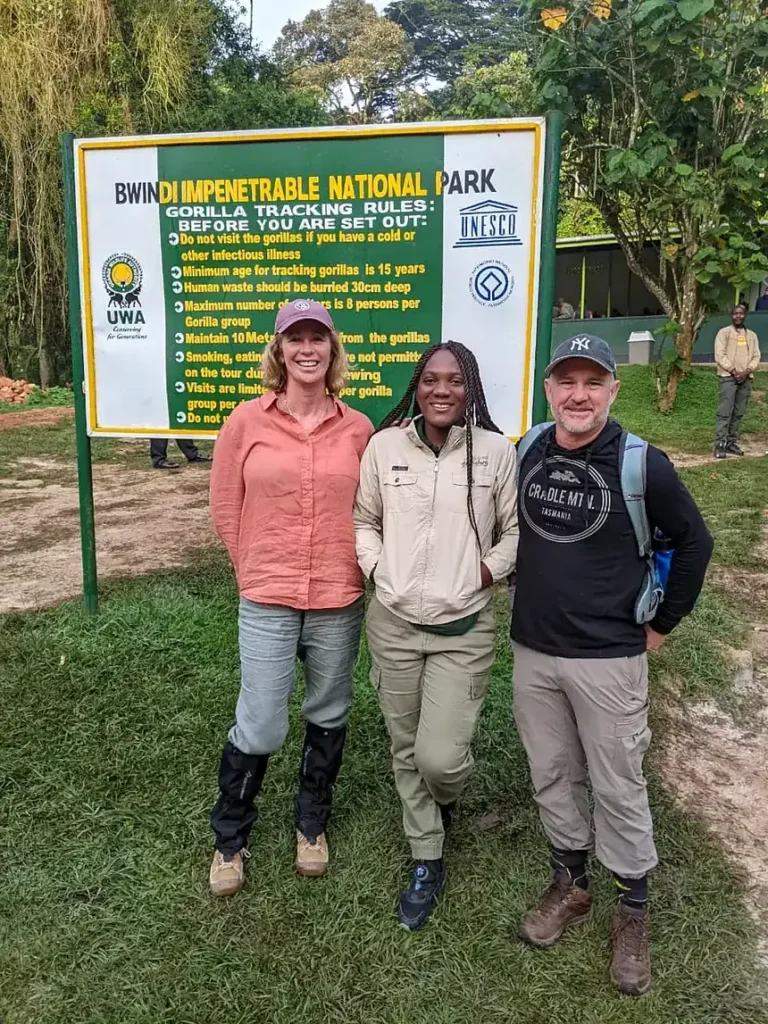
Any infectious illness on trek day stops you, because gorillas catch human diseases. Uncontrolled heart or lung disease and very recent surgery should also wait until your doctor clears you.
- A cold, flu, or other infectious illness. Uganda Wildlife Authority rules say you may not visit the gorillas if you are sick. Rangers can turn you back on the morning.
- Uncontrolled high blood pressure or heart disease. Hours of climbing at altitude put real strain on the heart.
- Severe lung disease. Bwindi sits between about 1,160 and 2,600 meters, and the air is thinner than at home.
- Very recent surgery. Wait until your surgeon is happy for you to walk on rough ground.
What Should You Ask Your Doctor Before Gorilla Trekking?
Ask your doctor whether you can safely walk uphill on muddy ground for several hours at up to 2,600 meters, a long way from a large hospital.
- Is my condition stable enough for several hours of hill walking?
- Is moderate altitude safe for my heart and lungs?
- Do any of my medicines react with antimalarial tablets?
- Which vaccines do I need for Uganda?
- What should I carry in my daypack in case of trouble?
Take this list to your appointment, along with our guide to how hard gorilla trekking is, so your doctor knows exactly what the day involves.
Tell Us About Your Health, Privately
Share your condition and how far you can walk. We will plan your sector, porters or sedan chair, and lodge around it, and keep what you tell us private.
Ask on WhatsApp Email LindahWhatsApp +256 784 240480 · lindah@pomelo-ibisadventures.com
What Medical Help Is There Near Bwindi?
Bwindi Community Hospital is in Buhoma, at the edge of the park, and every Pomelo-Ibis Adventures trip includes emergency medical evacuation cover through BARSOS.
- Bwindi Community Hospital is a general hospital in Buhoma, near the northern entrance of the park. It is one more reason we usually choose Buhoma for guests with health conditions.
- Emergency evacuation through BARSOS is included in every trip we run.
- Our guide stays with you and is reachable throughout your trip.
For serious care, patients are usually moved to Kampala. That is why your own travel insurance must also cover medical evacuation. Our guide to travel insurance for senior gorilla trekkers explains what to look for.
Do You Need Vaccines for Gorilla Trekking in Uganda?
Uganda no longer requires a yellow fever certificate for entry, following an immigration notice on 2 October 2026, but yellow fever vaccination is still recommended. Ask a travel clinic about malaria tablets too.
Yellow fever still exists in Uganda, so the change affects paperwork, not risk. If you cannot have the yellow fever vaccine because of your age or a medical condition, discuss it with your doctor before you travel.
How Do We Plan Gorilla Trekking Around Your Health Conditions?
We plan around your condition by choosing the gentlest sector, the right support, a lodge with easy paths, and a flight instead of a long drive.
- Sector. Usually Buhoma, the lowest sector and the one nearest a hospital. See the easiest Bwindi sector for seniors.
- Support. One or two gorilla trekking porters, or a sedan chair.
- Lodge. Short, flat paths, rooms close to the main area.
- Travel. A 75-minute flight instead of an 8 to 10 hour drive.
- Briefing. Our guide tells the rangers about your condition before families are assigned.
Want this planned for you?
Our 5 day gorilla safari for seniors keeps the pace gentle: a flight instead of a long drive, a rest afternoon before the trek, and BARSOS evacuation cover. $6,215 per person.
See the 5-Day Senior SafariFrequently Asked Questions About Gorilla Trekking With Health Conditions
Can I go gorilla trekking after a knee replacement?
Yes, usually, once your surgeon is happy for you to walk on rough ground. Two porters and the Buhoma sector make the trek much easier on a new knee.
Can I go gorilla trekking with high blood pressure?
Yes, if your blood pressure is controlled and your doctor approves. Bwindi reaches about 2,600 meters, so a slow pace and regular rests matter.
Can I go gorilla trekking with a heart condition?
Ask your cardiologist first. Guests with stable heart conditions sometimes trek using a sedan chair, which removes most of the physical strain.
Can I trek gorillas if I have a cold?
No. Uganda Wildlife Authority rules do not allow visitors with a cold, flu or other infectious illness to visit the gorillas, because gorillas can catch human diseases.
Do I need a yellow fever certificate for Uganda?
No. Since 2 October 2026, a yellow fever certificate is no longer required for entry to Uganda, but vaccination is still recommended.
5-Day Senior-Paced Gorilla Safari, $6,215
Flights from Entebbe, a gorilla permit in the sector that suits you, an easy-access lodge, and your porters or sedan chair reserved in advance.
Check Dates on WhatsApp Email LindahWhatsApp +256 784 240480 · lindah@pomelo-ibisadventures.com