How long does gorilla trekking take? there’s a version of this answer you’ll find on every site: “30 minutes to 8 hours, it depends.” True. Also useless.
Here’s the real one, from 18 treks I’ve personally done since we started Pomelo-Ibis in 2019, plus hundreds more we’ve arranged for clients. Real families, real times, real stories, including the one where I nearly cried on my own trek and the one where a gorilla fight almost broke out in front of a couple doing habituation.
Quick Answer
| Phase | Typical time |
|---|---|
| Breakfast to jeep | 5:30–6:40 AM |
| Drive to park HQ | Depends on lodge location. Under 20 min for our guests |
| Registration + cultural welcome | 7:00–7:30 AM |
| Grouping + briefing | 7:30–9:00 AM |
| Walk/drive to trailhead | Varies by sector |
| Hike to the gorillas | 20 minutes to 5+ hours |
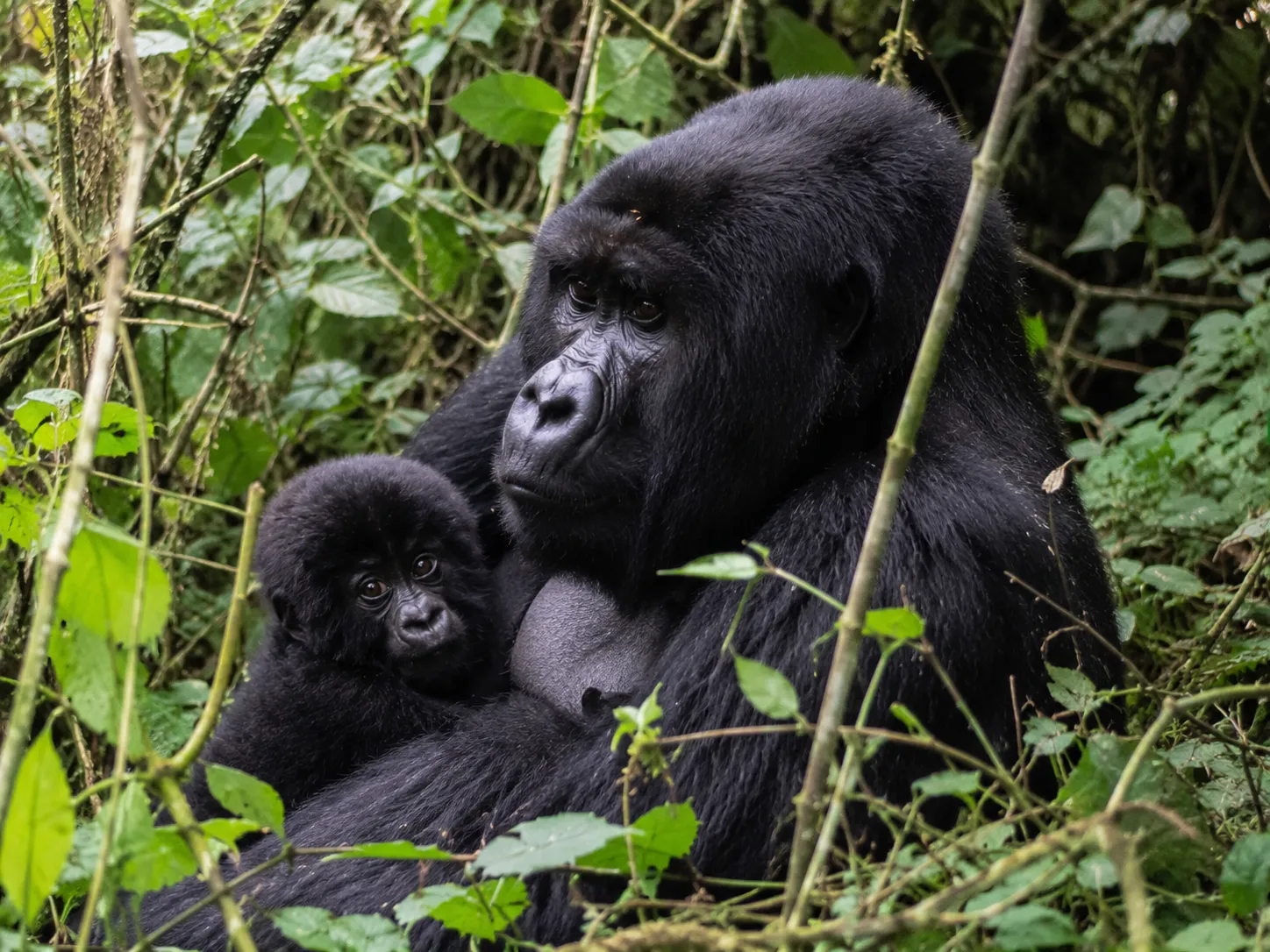
| Time with the gorillas | Exactly 1 hour, no exceptions |
| Return hike | Usually faster, but not always |
Total day: most people are back between 1 PM and late afternoon. On a hard day, later. There is no way to promise a number, and anyone who does is guessing.
What our actual mornings look like
Most sites describe a generic “7 AM briefing.” Here’s what actually happens, and why.
We put our guests in lodges under 20 minutes from park headquarters, deliberately, especially for older clients. Breakfast is 5:30–6:30 AM, and we’re in the jeep by 6:40 so we’re at the gate before 7. That’s not about beating traffic. It’s about getting there before the other operators so we can talk to the rangers who’ve already been in the forest tracking overnight movement, request a family that isn’t deep in, and grab the good walking sticks. If we’ve pre-booked a sedan chair, this is also when we secure the best one. If a client has a mobility limitation, this is when we flag it to the ranger who’ll lead our specific group.
Registration starts around 7:30, with a welcome from local community women: songs and dances tied to the culture around the forest, which most guests don’t expect and end up loving. Groups of 8 get assigned around 8:30, briefing runs a few minutes, and you’re usually entering the forest by 9.
As Pomelo-ibis, we don’t do packed lunches. You won’t have time or hands free to eat one while trekking, and you can’t eat at all during your hour with the gorillas since your mask stays on the whole time. We feed people a proper breakfast, then a hot lunch back at the lodge afterward. Bring water, at least 2 liters, and a small snack if you want, though most people come back with it untouched. They’re too excited to think about food.
The Gorilla Family and sector are a big player in your trek
You don’t choose your gorilla family. Rangers assign based on your fitness and where trackers last saw the group that morning. But over 18 treks across all four Bwindi sectors, patterns show up.
Buhoma is the sector we recommend for older clients or anyone with mobility concerns, no exceptions. The Rushegura and Mubare families tend to feed close to the starting point, so treks here run shorter and gentler more often than not. I tell every client with limited mobility: sleep at a lodge near Buhoma headquarters and ask for one of these two families. It’s not guaranteed. These are wild animals with territories, not pets waiting for you. But the odds favor you here.
Ruhija sits at Bwindi’s highest altitude, and it shows. Slower pace, more rest stops, even for fit people.
Rushaga has around 10 families, so permits are easier to get here in a pinch, but duration swings widely family to family.
Nkuringo is the hardest, and I know because it broke me on my very first trek. More on that below.
.
Planning For Comfort
Trekking with older parents,
or limited mobility?
Tell us who's coming and what they can manage. We'll match the sector, lodge, and gorilla family to the group, not the other way around.
Katiiti House, Kajjansi · Mutungo Hill, Kampala · Uganda
A real comparison: same guests, two families, back to back
The last time I was in Rushaga with clients, we tracked two different families on consecutive days.
Day one, they tracked the Nshongi Family, entered the forest, and were back in a little over 2 hours total. They found the gorillas in 30–40 minutes, spent their hour, and were out in another 30–40 minutes.
Day two, they tracked a different family called Kutu. They entered around 9 AM and didn’t return until after 4 PM. Why? It rained heavily that morning. The family kept feeding deeper into the forest instead of settling, and rain slows everything: the trail turns to mud, people slip, some want to stop out of fear rather than exhaustion. It took roughly 3 hours just to find the gorillas that day, though once found, the hour was the hour, same as always.
Same operator, same week, same guests. One trek was 2 hours. The next was 7+. That’s the honest range, not a marketing range.
What nobody tells you about the physical toll
My first ever trek was Nkuringo, before I had trained for any of this or even knew what training for this meant. The descents nearly finished me. My legs were shaking on the way down, and the pain ran from my waist to my feet. I was with friends and too proud to admit I was struggling, so I said nothing and just endured it.
The next morning I couldn’t lift my legs off the bed. I hobbled to breakfast in real pain, got some ointment, and had a friend massage my legs, which helped more than I expected. That trek taught me the hard way that gorilla trekking is a physical event you prepare for, not a walk you show up to. I started training properly after that. Every trek since has been easier, not because the terrain changed, but because I did.
If you take one thing from this: train before you come, especially on inclines. Stair climbing and hill walking prepare you far better than flat cardio.
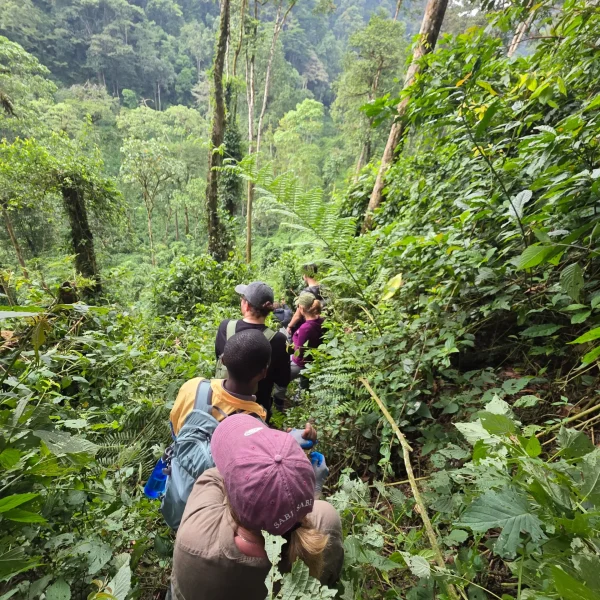
Hire the porter. Every time. Even if you're fit.
This isn’t a suggestion I make lightly, and I’ve watched what happens when people skip it.
A client in her thirties, fit, in Rushaga, came with a big camera and three lenses, a small backpack, a water bottle, and a lodge-packed snack. I told her to hire a porter. She said she didn’t need one; she was young and capable. Minutes after entering the forest, it started raining. She fell repeatedly trying to grab wet branches for balance with no free hand, while the rest of the group (eight people trek each family at a time) watched and laughed. She told us afterward it ruined her experience and she wished she’d listened.
A porter costs $20–25 and will walk beside you, hold your hand on the descents, carry your bag, and free both your hands for the actual terrain. Bwindi is a mix of lowland and montane rainforest, with wet leaves and mist on the ground even when it isn’t actively raining, so the ground is rarely as stable as it looks.
There’s also a part of this that has nothing to do with your comfort. Many porters are ex-poachers rehabilitated back into the community by Uganda Wildlife Authority: men who used to hunt these same forests and now make their living helping people experience them safely. The $20–25 you pay goes toward school fees and food for their families. You’re not just buying free hands. You’re funding the reason poaching in this area has gone down.
If you genuinely can't continue..
This happens more than people admit, and it’s handled with more nuance than “a sedan chair shows up.”
A friend of mine guided a client who had been under-eating the entire week of her safari, skipping real meals for light snacks and watching her calories the whole trip despite being told to eat properly before a trek this demanding. On trek day, no breakfast, straight into the forest. Halfway in, she ran out of energy and began slowing the whole group, which moves at the pace of its slowest member by design. Eventually she couldn’t continue at all.
Rangers communicate by radio between the forest teams and park headquarters. The first option is always reassignment: moving you to a nearby group tracking a different family that’s closer or moving slower. If that’s not possible, the second option is a sedan chair, carried by porters, to bring you out of the forest. In her case, it came to that. The chair cost her $500, an expense she hadn’t budgeted for, on top of the permit.
People end up in this position for all kinds of reasons: genuine exhaustion, fear, underestimating the terrain, or sometimes just being caught by weather at the wrong moment. All Pomelo-Ibis trips include BARSOS emergency medical evacuation cover as standard, which matters more than people think until the day they need it.
The Gorilla Habituation Experience, and the day it went sideways
This is a different product from standard trekking, and worth knowing about even if you don’t book it: instead of one hour with a fully habituated family, you get up to four hours with a family that’s still semi-habituated and still getting used to human presence, still unpredictable in a way fully trekked families aren’t. It’s only offered in Rushaga, costs $1,500 against $800 for a standard Uganda permit, and only 8 permits are issued daily.
I watched a video of a couple who did a normal trek one day, loved it, and came back for habituation the next. They were sitting with the family, watching the silverback, the females, the young, when an outside silverback that had never seen a human in its life came out of nowhere to challenge for dominance. The two silverbacks fought, right in front of the group. The rangers, trained for exactly this, kept everyone safe, but the couple later said it was one of the most terrifying things they’ve ever experienced, and also one of the best. They still talk about it.
That’s rare, maybe 1 in 100 habituation treks sees anything close to it, but it’s the kind of thing that can only happen when the gorillas aren’t fully used to people yet. It’s a fair trade for anyone who wants a rawer, less scripted encounter and has the budget and fitness for a longer day.
How many days you actually need
The trek itself is one day, but getting there isn’t instant. Budget a minimum of 3 days for Uganda: travel to Bwindi, the trek, travel back. Most guests are more comfortable with 4–5, especially if pairing it with other wildlife time. We run fly-in transfers via AeroLink or Fly Uganda from Entebbe, under 90 minutes each way, which cuts down the road option (a full day’s drive) considerably if time is tight.
Frequently Asked questions
Usually 4–8 hours door to door, but we’ve had it wrap in under 3 and stretch past 7 on the same week with the same guests, purely because of rain and where the family fed that day.
Exactly one hour. No exceptions, no extending it, no matter how good the moment is. (The Habituation Experience is the one exception, at up to four hours.)
Buhoma, most reliably, specifically the Rushegura and Mubare families. Still not guaranteed; they’re wild animals with territories, not on a schedule.
Yes. Fitness doesn’t protect your hands and back from carrying gear on wet terrain, and the money supports rehabilitated ex-poachers and their families directly.
angers will first try to reassign you to a closer or slower-moving group. If that’s not possible, a sedan chair carried by porters brings you out. Budget roughly $500 if it comes to that.
Ready to Actually Plan the Trek?
Sector, family, lodge, fly-in timing: this is the part we handle for every guest before you set foot in the forest. See how we build a gorilla trekking trip around you.
Explore Gorilla Trekking With Us